The logistics automation market is growing rapidly. Thus, in 2020, its volume was $48.4 billion, and in 2026 it is projected to increase to almost $89 billion. Such growth is explained by the spread of e-commerce worldwide and the emergence of technical innovations, including robotics. Automation allows you to speed up delivery and operate costs while maintaining efficiency. In this article, we will discuss what processes can be transferred to auto mode using digital technologies and how this will affect the business.
-
Briefly about the essentials: the essence of logistics automation and its components
Automation in this industry aims to increase the efficiency of work processes and operations. For this, both digital solutions and automated mechanisms, such as robots, can be used. Based on this logic, we can distinguish two groups of components that simplify the performance of logistics functions.

These components are:
1. Software.
- Business management solutions: work with incoming and outgoing stocks, planning and fulfilling orders;
- Solutions for operational control: support in making decisions to ensure continuous operation of a company;
- Integration solutions: monitoring the functioning of the entire automation mechanism in an enterprise;
- Radio data terminals: maintaining communication between logistics and transport, object identification (barcodes).
2. Hardware.
- Stationary equipment that operates based on digital solutions;
- Storage and retrieval systems, such as cranes and warehouse maintenance machines;
- Transport equipment that moves containers without the participation of an employee;
- Robots that perform simple routine tasks, such as laying out products.
Usually, automation (both software and hardware) concerns the tasks and functions that are implemented in warehouses. But everything is much bigger. You can automate absolutely all points and links of the logistics path for processing, preparing, executing, and sending orders. We will talk about this further and give examples.
Opportunities for logistics path automation
Logistics automation is useful for all companies involved in supply chain management. Recall that the supply chain covers all stages of production and delivery: from purchasing materials to shipping the finished product. Logistics is one of the components of this chain. In one way or another, manufacturers, suppliers, sellers (offline and online), fulfillment companies, and transport organizations are connected.

How the links of the logistics chain are automated:
1. Darkstore
It is an important logistics hub, a warehouse for quickly collecting orders for online stores. It can be compared to a supermarket: an assembler moves around the premises and collects the necessary goods from the assortment on the shelves. Special apps help them with this.
Automation options for darkstore:
- “Smart” navigation. Apps are responsible for the speed and convenience of assembly. They independently build routes for the assembly of goods for several orders simultaneously;
- Accounting systems. Goods are categorized and stored on numbered racks. Accounting is kept in special digital systems;
- Services for assortment control. They “see” the quantity of products and ensure timely replenishment from distribution centers (DCs).
2. Distribution center
This warehouse receives large goods shipments from other warehouses (distribution centers or those where finished products are stored). Here the goods are assembled and sent in small batches to the next points in the chain. The DC also stores insurance stocks, which can be replenished at any time in the store's warehouse.
Such a warehouse is much larger than a darkstore (up to 100,000 sq. m.). Goods are placed on pallets or racks, including up to 6 tiers. Acceptance and shipment of goods take place at cross-docking sites. Logically, many employees are involved in the work. IT tools are responsible for work control and quick adaptation to changes.
Automation possibilities for DC:
- WMS-system. This is the foundation for any DC. Its functionality allows users to perform daily warehouse operations centrally using mobile and voice terminals. There are many logistics automation examples: registration of incoming cargo, checking movements, tracking load according to criteria (serial number, barcode, product code, expiration date), document flow, and more;
- Personnel control systems. They perform a comprehensive control of the work of employees: from moving around the territory to hourly accounting for shifts and calculating payment according to the schedule;
- Yard management solutions. Such systems are tailored only for the control of transport, namely, for monitoring its location on the territory. It allows you always to be aware of what the loaders are doing and plan their work schedule;
- Scanners. Devices work with labels. They recognize the code and use it to track the legal origin of the product, i.e., where it came from to the warehouse.
3. Fulfillment center
The tasks of this center intersect with the tasks of the darkstore. Online orders are also processed here. But there is a significant difference in volume. Such centers receive large batches that need to be completed and sent further (to the customer or for sorting).
Such centers are superior in size to other links in the chain. And it is not surprising because they are used by online retail giants such as IKEA. By the way, the Swedish retail chain went further and integrated fulfillment into its stores. This made it possible to combine logistics for online and offline trade.
Note that centers can automate activities in any of the ways described above. However, this is where innovative technologies are most often used. Why? It's all about scale. The center often reaches 140 thousand sq.m. In such conditions, technologies for automated order picking are a real necessity.
Automation options for fulfillment centers:
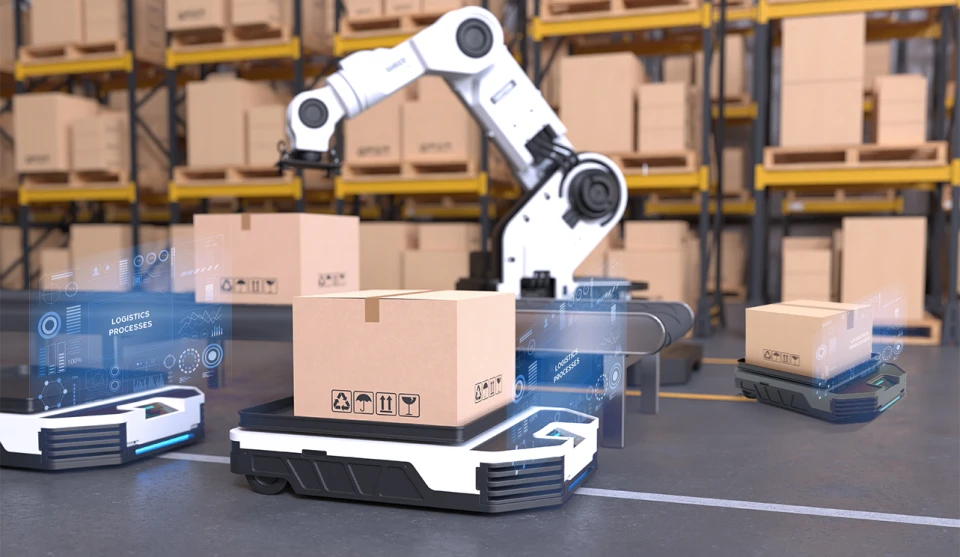
- Robotization. Robotic carts (moving pallets, shelving goods), sorting robots (identification and packaging), robots with RFID readers (continuous inventory), and flying drones (situation monitoring). All of them optimize space and speed up operations;
- Smart conveyors. These are service-oriented devices based on various technologies: IoT, big data, computer vision, machine learning, sensors, robots, and VR/AR. Conveyors collect, analyze data, and provide solutions for logistical challenges;
- Electronic accounting. The accounting system connects the center with the online store, displaying information to sellers about available items. It also includes the auto-order system, which notifies you of the need to replenish stocks and prevents situations with too many items.
4. Buffer storage
We mentioned this link when we described the DC. These are the premises where the finished product is located (used in situations where demand rises sharply). There may also be materials and raw goods. In any case, these “reserves” are stored for a short time – from several weeks to months. As a rule, such points are located at production and transport hubs.
Buffer warehouse automation options:
- Elevator system. It is a vertical lifting storage system that uses the maximum height of the warehouse;
- Conveyor system. It is responsible for the rapid movement of goods to the packing station over an area of up to 10 thousand square meters;
- Logistics management system. The main option remains the WMS system, which we talked about above.
5. Sorting center
The functions of such a center are limited to sorting. The center receives the parcel, scans it, and sends it further (as an option, immediately to the recipient). The duties of sorters do not include packaging. This link can be called intermediate since we are only talking about redirecting the cargo.
It is logical that the emphasis is on technology for identifying parcels. Usually, these are not only scanners (as we remember, they are also used in the DC) but also sorting machines. The latter is a specific feature of such centers.
Automation options for sorting centers:
- Sorting machines. In fact, it is an industrial robot in the form of a conveyor belt. It organizes goods into different categories, such as destinations;
- Scanners. The device reads the barcode, determines the weight and size of the items, and also registers it in the system;
- Tracking systems. Here, the package's current status is recorded after it has been transferred to the next point.
As you can see, there are many automation options for each point of the logistics path. We have described only those most often used at one stage or another. Most of these digital and hardware solutions can be used everywhere.
For example, WMS is the basis of any warehouse. And the help of a robot can be useful both in a large fulfillment center and in a small darkstore. Of course, there are also individual solutions. The simplest example is a package sorting machine. A more specific example is predictive analytics which predicts demand (based on which the store can plan stocks).
As you can see, supply chain automation is one of the brightest trends in logistics. The automated supply chain management system is actively used with an emphasis on warehouse and transport operations. It simplifies order handling, ensures the rational use of stocks, and improves data accuracy.