
First, the pandemic, now the Russian-Ukrainian war and inflation did not have an incredibly negative impact on the insurance industry. According to PWC, in 2022 global non-life stocks increased from approximately 864 billion US dollars to 960 billion US dollars, which represents an increase of 11% compared to 2021. The increased demand for services in this area increases the workload of companies and predetermines the further way of its development in the direction of global automation. In this article, we will discuss the main insurance automation ideas and how they can help your business.
How Insurance Automation Became a Trend
In simple terms, automation is the transfer of functions, earlier done by humans, to a machine. Insurance automation involves using various tools to improve all industry operations: marketing, sales, document management, and communication with policyholders. The most common is the use of RPA, artificial intelligence, and its particular case – Machine learning in insurance.
According to Statista analytics, insurers are increasing their spending on automation every year. While in 2016, their spending on RPA and AI was $76 million, in 2022, this amount increased by 889% to $752 million. So what drove this change? Probably the realization of all the benefits that the insurance business can gain by eliminating manual labor partly. Let's look at them in more detail.
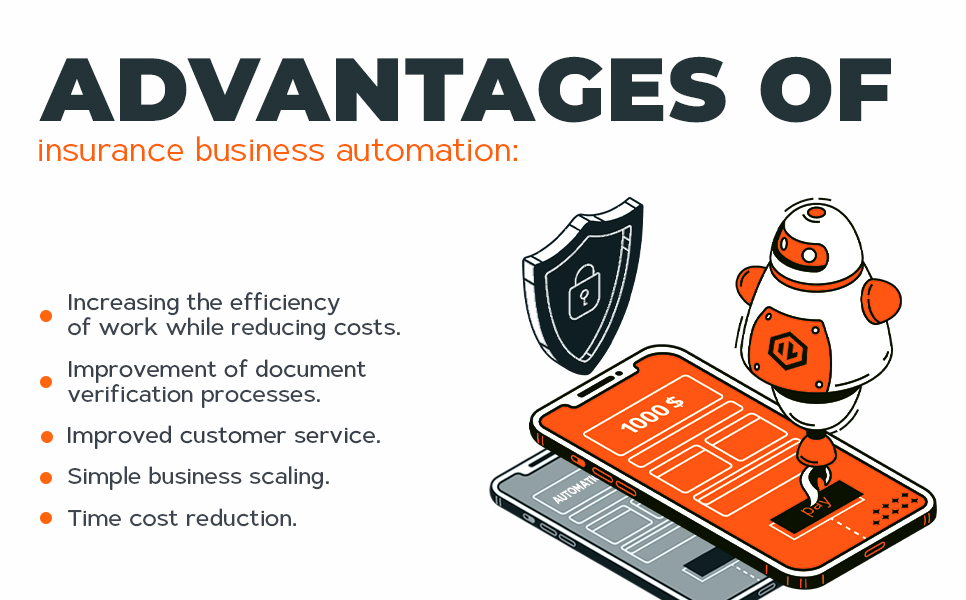
- Increasing the efficiency of work while reducing costs. Due to the nature of their business, insurers are constantly dealing with large volumes of information. Processing it manually is a time-consuming and costly process. Automating data processing can reduce the length of procedures and save your budget simultaneously. For example, a McKinsey report states that claims processing costs can be reduced by 30% due to automation.
- Simple business scaling. If a company needs to add new bots, automation makes it possible to fulfill this need without high financial costs. Unnecessary tools can be abandoned just as quickly as they can be implemented.
- Improved customer service. Insurance is a very specific industry where customer dissatisfaction is common. You can increase their loyalty through better customer service. Automated systems process incoming.
- Improvement of document verification processes. Customers must provide the insurer with a lot of specific documentation – such as proof of the amount of damage and the cause of it – in order to receive reimbursement for an insured event. These papers are easy to forge, and the company will incur substantial losses if an employee fails to notice them. RPA will scan the document and use special algorithms to verify its authenticity.
- Time cost reduction. Experience of the large Australian insurer QBE showed that you could save up to 10,000 working hours per year just by automating the acceptance of claims. That corresponds to the working hours of 25 full-time employees. It doesn't mean that robotized systems will completely replace human resources in insurance – all released time can be used for sales promotion, marketing strategies development, etc.
All of the above suggests that, like it or not, the era of automated systems, robots, and AI has already begun. And you can remain competitive in any sphere, including insurance, only by keeping up with the trends of the modern world.
5 Aspects of Insurance for Which Automation Is Important
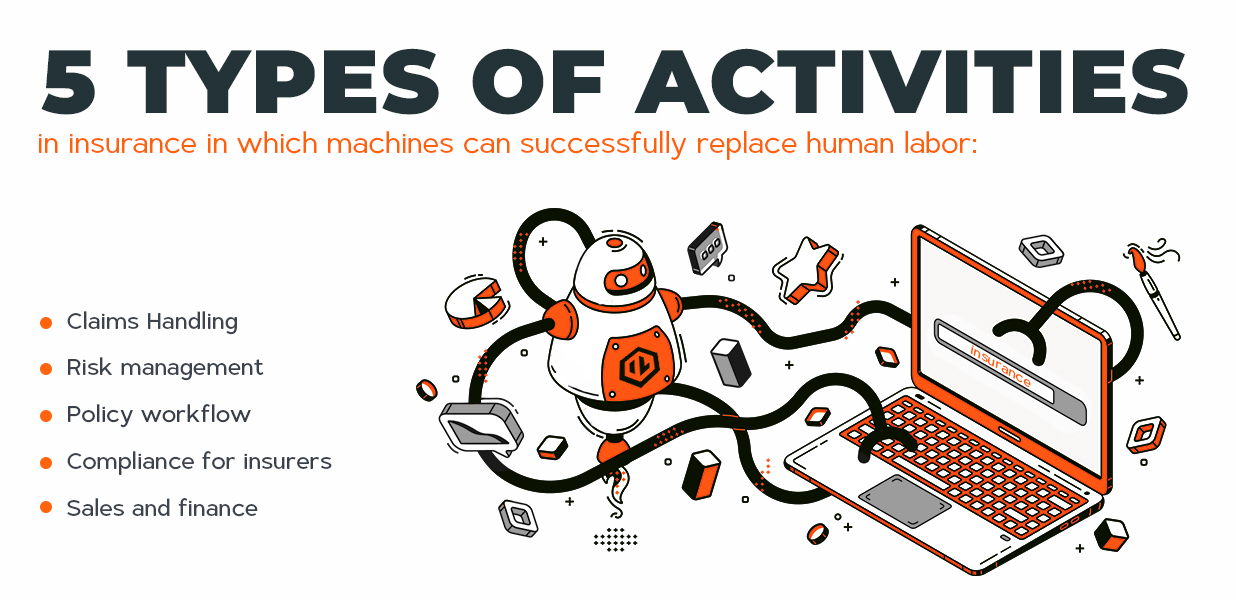
Do you want to see positive results from implementing intelligent process automation in insurance in the near future? It is crucial at the very beginning to properly prioritize and determine what must be automated and what must be performed by humans. Let's look at 5 types of activities in insurance in which machines can successfully replace human labor.
Claims Handling
Receiving claims from insureds is one of the responsibilities that take up the most staff time. The lengthy process of reviewing documents can cause dissatisfaction among customers, who, for the most part, expect a quick reimbursement.
In the case of manual labor, it can take several days because it involves reviewing information from police or medical facilities, photos of damaged objects, etc. In addition, data entry errors (again, the notorious human factor) entail an unforeseen increase in the required time and finances.
Automate this task, and the problem will be solved.
Practical use
An insurance company receives a claim for an insured event. If the procedure is automated, processing such a claim is the responsibility of the RPA bot, based on ML technology, instead of a human. It analyzes the received data and, in case it complies with the terms of payments, submits an application for payment. If the data provided in the document is insufficient, the application passes to the manual processing status. During the insurance agent's work with the application, the bot "learns" and uses this experience in further practice.
Risk management
Risk analysis, or underwriting, is mandatory in the insurance business. It can help you avoid higher costs by setting adequate rates and other insurance contract terms.
For example:
- Insurance payments will increase if the client works at a dangerous job.
- The insurance payout in the event of the policyholder's death is limited to their financial situation when the insurance is issued.
- The amount of insurance payments directly depends on the applicant's credit rating.
- If double insurance (registration of insurance for the same object in several organizations) is detected, the client must be checked for fraud.
All these manual steps may take up to several weeks. The automation of risk management can completely solve this problem.
Example of use
The bot receives a package of documents from the applicant, extracts the necessary information, consults external data sources to verify their correctness, and generates a decision on tariffs and other insurance terms.
Policy workflow
Another example of a task requiring Insurance workflow automation is issuing new policies and updating existing ones. After the underwriting and verdict on the amount of bonuses and benefits, all of this information must be entered into the system and passed to the client. The same actions are required in case of the contract renewal.
Example of usage
An e-mail is sent to the client requesting an amendment to the policy with supporting documents. Using Optical Character Recognition (OCR) or speech recognition (NLP) Insurance technology platform retrieves the necessary information and makes the changes to the policy and the company's internal database.
Compliance for insurers
It would seem that what's so difficult about building your business in compliance with regulatory requirements? But the thing is, these requirements can change, and all updates need to be made promptly to internal documentation and reorganize established processes. Automation can help in this case as well.
Example of usage
One of the use cases of RPA and AI is the automation of verifying insurance transaction participants' affiliation with sub-sanctioned and politically exposed persons. Bots can analyze an alert received about the possible special status of a policyholder or payee and use external data sources to verify such information for authenticity.
Sales and finance
Selling insurance policies and maintaining financial records is integral to insurance agents' daily duties. It includes legally vetting potential clients and monitoring their creditworthiness, creating reports on completed transactions, handling payroll, and more. These are all very time-consuming if done manually. But Insurance workflow Automation software can make routine tasks much easier.
Example of usage
RPA perfectly copes with filling out document templates, creating reports, calculating insurance costs, and checking the creditworthiness of applicants.
As you can see, most procedures in the insurance business can be accomplished with the help of machines, not only without detriment to the company but with a massive advantage for it. According to the McKinsey resource, in 8 years, 44% of all activities of insurers will be automated. Well, let's see, perhaps such a global transformation will happen much faster.
Challenges of Moving to Automated Operations
When changing their approach to doing business, many insurance companies are slow to turn to new automated technologies. On the one hand, it's understandable because insurance automation comes with its own set of challenges:
- Unstructured and multi-format data. All information is transmitted within the insurance system in different ways: via e-mail (in the body of the letter or as an attachment), in phone conversations with the manager, and on internal online platforms. In addition, a large amount of information is still stored in handwritten form. For a complete transition to the Insurance workflow management system to be possible, it is essential to bring all the available information into one format – to digitize it.
- Patchwork automation. The concept means using several systems in a company that cannot fully interact. For example, an insurance company's latest CRM system will undoubtedly facilitate customer service. But the accounting department, which continues to work with outdated software, will have to manually enter all the data obtained through the CRM. The situation can be saved by ordering from an experienced developer Insurance technology platforms – comprehensive solutions capable of automating all major processes in insurance.
Cyber security is an important aspect of automation.
The insurance industry has always been susceptible to cyber-attacks. This is due to the huge amount of important information that is digitized with the growth of automation. After all, in order to issue insurance, we must provide contact information, financial information, and even health information. That is why it is important to take care of data security when creating convenient conditions for customers, digitizing and automating insurance processes.
Cybersecurity Ventures predicts that global cybercrime spending will grow by 15 percent per year over the next three years to reach $10.5 trillion annually by 2025, up from $3 trillion in 2015. That is why when planning automation, do not miss the issue of cyber security and create a safe environment for your customers.
Despite the challenges that arise, automation is necessary for the insurance industry. All processes contain routine, time-consuming tasks, from internal paperwork to customer communication. Insurance automation frees up to 80% of agents' time and allows them to focus on more complex operational duties.