Serious changes in e-commerce began in 2020 under the influence of the pandemic. According to the European E-commerce Report 2021, the total industry volume reached €757 billion in 2020. It is 10% more than in 2019. At that time, thousands of offline stores decided on digitalization of business to create a secure shopping experience. But the transition is not yet complete. The role of digital experience in commerce is increasing every year. We will talk about how digital technologies affect the industry. You will also learn which processes should be digitized and how to automate e-commerce business.
Digitization Role in E-commerce
Let's start with a brief explanation of the essence of digitization. This phenomenon can be characterized as the active implementation of technologies in various industries, including e-commerce. But everything is much deeper. It is a global rethinking of the approach to doing business by optimizing and automating critical business processes.
As we noted above, this rethinking in e-commerce began during the pandemic and continues today. We can highlight four driving forces of this process:
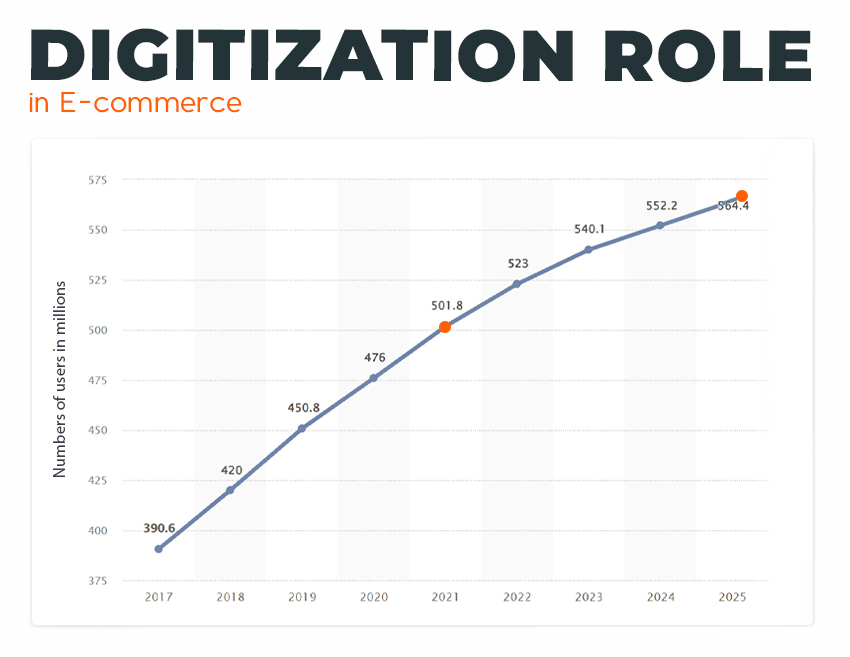
- A massive shift of buyers to online. According to Statista, the number of e-commerce users in Europe increased to $502 million in 2022. And by 2026, this figure promises to grow by another $62 million.
- Increased customer expectations. Today's customer expects a personalized shopping experience across all possible channels.
- Online presence is a must. Now it is difficult to achieve success only offline. It depends on the online strategy and whether the business can find its niche in the market.
- High-tech competition in the industry. Technology stimulates the buildup of business in the market, meaning it helps to overtake competitors.
Previously companies implemented technology at will. And now it has become a necessity. It's not just about moving online to keep in touch with customers. The company must transform the internal business processes on which commerce is built in order to achieve excellent results: orders, pricing, marketing, purchasing, delivery, etc.
Doing such deep and large-scale work is called digital transformation. How does this concept differ from the digitization with which we started? The fact is that it has three levels. And when a company fulfills them all, it means that it has managed to transform. Let's talk about these levels.
Path to Business Digital Transformation
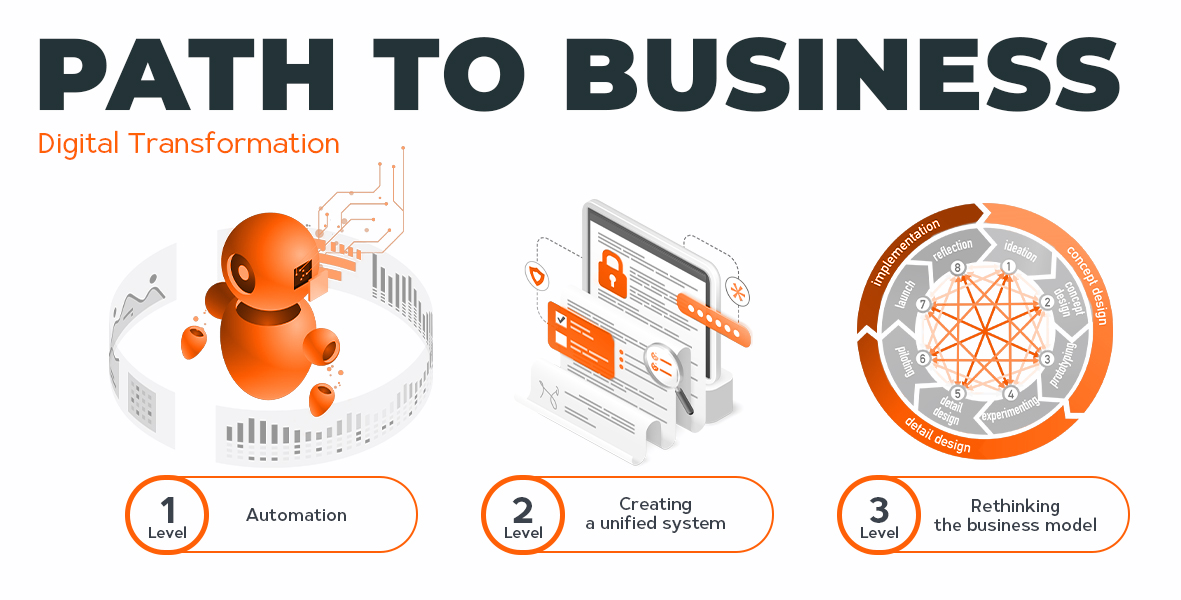
Level 1. Automation
It all starts with the automatization of the e-commerce business. The goal is to automate routine business tasks and repetitive operations. Routine tasks pass under the control of a software and hardware complex.
Automation helps to:
- Increase profits (and reduce staff costs) by serving more customers with fewer employees.
- Reduce time costs due to the efficient distribution of orders between managers according to the current schedule.
- Improve the accuracy of results in processes where mistakes are fraught with serious consequences, e.g., issuing invoices.
- Set up difficult or impossible processes to perform manually, e.g., replacing calling thousands of customers with automatic emails.
Thus, taking orders, invoicing, sending letters to customers, and performing other simple tasks no longer require an employee. Let's look at business process automation's essence in billing examples.
- A manager accepts an order (1) and calls a client to clarify the details (2). They then create a report in Excel by copying the old invoice (3) and send it to a client (4). The manager periodically calls an accounting department to determine if a buyer paid the bill (5). And only after receiving the money can send the goods (6).
- The system processes an order from a client, where the details for invoicing are specified (1). The invoice is automatically sent to the client by mail (2). After paying the invoice, the manager receives a notification and sends the goods (3).
In the first case, the manager must perform six steps independently. In the second case, there are only three steps, and the system is responsible for them. This example perfectly demonstrates the difference in time and effort spent in manual and auto modes.
What are the pitfalls?
Some entrepreneurs are so eager to speed up the transition to the auto mode that they try every new technology that comes on the market. As a rule, they follow the principle of “must try” or take a cue from competitors. It leads to patchwork automation.
It means applying services independently of each other. These e-commerce automation tools are usually not compatible. This approach allows you to optimize only certain areas, meaning automation will be local, and you will not get the maximum benefit.
In addition, sometimes, the automation of one process negatively affects another. Imagine that you have implemented CRM. It became easier for your salespeople but more difficult for your accountants. Now they are forced to manually transfer data from Google Sheets to CRM and carefully compare prices. You can avoid problems by integrating programs.
So you take a step to the second level.
Level 2. Creating a unified system
It is essential that all tech components are connected. To do this, they must be combined into a single system. This avoids the technical and organizational difficulties that arise when components are not compatible with each other. Such an enterprise system can be developed from scratch for the company’s individual needs.
A unified digital system helps to:
- Ensure uninterrupted data exchange between the team and buyers, contractors (delivery service), and suppliers.
- Quicken management decision-making through single access to all data.
- Simplify maintenance and administration of various programs, thereby saving on this.
- Set up automated execution of chains of processes and related tasks.
- Improve the customer experience by connecting all channels to communicate with customers.
It is much easier to automate interrelated processes. Let's say that a warehouse ran out of goods. The system will automatically update the status of the product in the catalog on the site. Then it will notify the manager that there is a need for purchases, and also predict the required volume of goods, calculate the price, and offer relevant suppliers.
It is how the e-commerce digital business model starts to take shape. Next, you go to the third level.
Level 3: Rethinking the business model
Implementing the latest solutions and automating key tasks entails major changes for the enterprise. Each employee must learn to work in a single system and make decisions intelligently using the data this system generates and provides.
How to understand that transformation has occurred? The structure of work processes, the relationships between them, and the approach to management must change. First of all, the changes will be felt by top managers who are responsible for planning, controlling sales, and decision-making. In the future, each employee must adapt to new digital conditions.
Once again, such long-term deep work makes sense only when it is important to grasp all tasks and satisfy all needs.
Business Processes That Are Covered by Digital Transformation in E-commerce
Transformations should cover all operations and tasks on which online commerce is based. It is the only way to bring the activity to the highest digital level and get the maximum benefit.
What needs to be transformed and why:
- Marketing and customer experience. Objectives: access real-time customer information; personalization of the customer's path to purchase on all channels; marketing campaign management; shipping and returns management.
- Merchandising. Objectives: demand forecasting; multi-channel pricing; organization of ad campaigns; assortment planning; product operations; data management.
- Supplier relations and purchasing. Objectives: maintaining relations with suppliers; purchase analytics (based on AI); contract and invoice management; risk management.
- Delivery. Objectives: supply chain planning; maintaining relationships with contractors; inventory, warehouse, and logistics management; tracking delivery to the customer.
- Multichannel operations. Objectives: combining offline and online commerce capabilities to create a consistent shopping experience.
Business digital transformation is vital. Especially for such a highly competitive and in-demand industry as e-commerce. Digital technologies are expanding opportunities in all areas, from communicating with customers through different channels to logistics planning. In addition, thanks to automation, up to 90% of routine tasks associated with data processing and analysis are reduced.