

Interesting Fact: Statista states the IT outsourcing market reached $395 billion in 2022. It is projected to continue growing with a CAGR of 9%, resulting in a capitalization of $587 billion by the end of 2027.
SMB representatives and mega-corporations like Google, Microsoft, and others utilize outsourcing services. This is because this type of development is more advantageous than traditional (i.e., in-house) development in terms of cost and quality.
The experts at ISITLab have conducted their own research in this segment and are ready to share their results with you. From the material, you will learn about the following:
- Specifics of software development by dedicated professionals.
- Challenges that arise in software development.
- The difference between software development by in-house teams and hiring dedicated developers.
- Typical issues in each of the mentioned types of software development.
- Key advantages of hiring dedicated developers for businesses.
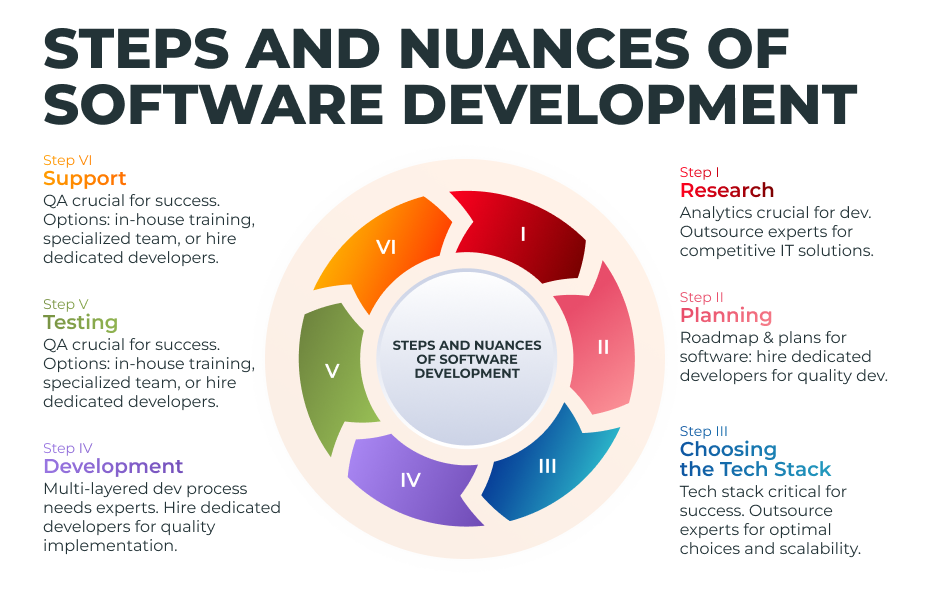
Steps and Nuances of Software Development
Let's start with the basics, specifically the processes of dedicated software development. Usually, the client doesn't care about the technical details of how the digital product is implemented. However, such indifference to technical aspects often leads to problems.
It's important to note that only a comprehensive service provided by dedicated teams can ensure your IT solution's good quality, competitiveness, and market viability.
Research
Analytics is an integral part of the development. It involves thoroughly analyzing the industry, ideas, business specifics, target audience preferences, and more.
Typically, in-house teams need more talent to evaluate the future software concept properly. This talent gap is overcome by hiring dedicated experts.
By outsourcing the project and hiring dedicated professionals, you gain a detailed industry overview and receive recommendations for developing an IT solution that can compete effectively in your chosen niche.
Planning
Developing a roadmap and clear step-by-step plans for software implementation, design, and architecture are important tasks that require sufficient industry experience.
Hiring dedicated developers allows you to compensate for the lack of in-house expertise and improve the quality of the development.
For example, ISITLab's service includes planning all key process operations, covering 99.9% of an organization's development needs.
Choosing the Tech Stack
The tech stack is a critical factor in development that influences an IT solution's potential, support, and scalability.
Hiring dedicated developers or teams allows you to delegate the task of choosing technologies to experts who know best what to integrate into your project, ensuring its high chances of success with the target audience.
Moreover, in-house experts may have limited skills, such as creating solutions based on JS when the business would benefit more from C#, Laravel, and so on. This can negatively impact the future development of your IT product.
Development
The actual software development process is multi-layered. It involves simultaneously working on design, code, architecture, API integration, interface, navigation logic, and more. Therefore, dedicated professionals with specialized skills are needed to create each element with high quality. However, companies often require more resources to maintain such professionals in-house.
Hiring dedicated developers is a panacea when you need to assemble an expert team for the quality implementation of your software.
Testing
Without proper QA, any digital product is doomed to fail. It's crucial to plan for software testing in advance. This can be done by:
- Training your in-house IT experts.
- Delegating the project to a specialized QA team.
- Hiring dedicated developers from a company that provides a full range of development and testing services, such as ISITLab.
The last option, hiring dedicated developers, is advantageous since you can obtain the highest possible quality for your digital product without additional costs.
Support
Bug fixing, addressing technical issues, system updates, and tech stack upgrades are often delegated to external organizations. By doing so, businesses make a crucial mistake that can be fatal for the viability of their IT solution.
Only a truly expert dedicated team developing the digital solution can provide comprehensive support for your project, including long-term software maintenance.
This significantly improves the chances of further developing your IT product and positively influences its scalability potential.
Scalability
You're making a strategic mistake if you implement a project without considering its future scalability. This mistake will negatively impact the efficiency of your business and nullify all investments made in developing the IT solution.
When hiring dedicated developers, negotiate software support and their involvement in scaling the project.
This greatly enhances their work efficiency, encouraging them to choose the right tech stack and prepare technical documentation. Ultimately, it also positively affects scalability, especially if handled by the same specialists conducting the development.

Hidden Pitfalls of the Software Development Process
According to PMI, approximately 12% of IT projects failed in 2021. Some of them didn't even reach the alpha or beta iterations. Several reasons contributed to this:
- Poor work organization
- Lack of project management experience
- Incorrect tech stack
- Inexperienced performers
- Other technical or organizational issues
This picture is complemented by the complexity of development, high industry standards, inflated expectations, and other factors. Let's discuss some of them further.
Quality
Cheap development and hiring inexperienced dedicated developers lead to a sharp decline in the quality of IT solutions. Usually, this translates into a budget drain and customer outflow from the project or the business itself.
To mitigate this threat, the software development task should be delegated exclusively to dedicated industry professionals, such as the team at ISITLab.
Speed
Development done by an in-house team usually takes longer than the same process carried out by dedicated experts, as company personnel may get sidetracked by solving external problems.
Therefore, outsourcing and hiring dedicated developers is an ideal opportunity to implement an IT project timely, increasing its chances of occupying competitive positions in the market.
Experience
Typically, in-house IT specialists perform the same tasks throughout their entire careers. This doesn't bode well for their skills and experience. Accordingly, if there is a need to develop a different type of digital solution, they cannot implement it properly.
On the other hand, dedicated experts engage in the development of IT products for various niches. As a result, they possess a broad arsenal of technological knowledge, including programming languages, frameworks, methodologies, and tools. This positively impacts the quality and speed of development.
Process Management
Agile and DevOps principles are considered the most popular development methodologies today. However, some teams continue to work in conservative (linear) ways, leading to increased development timelines and reduced product quality.
The absence of a professional manager in the team further complicates the development process, as it introduces operational inconsistencies among team members.
This problem is more prevalent among in-house development specialists, while it is mitigated within dedicated teams. Nevertheless, its negative impact on the quality of development and the final iteration of the IT solution cannot be ignored.
Learning from Mistakes
The cost of even the smallest mistake in an IT solution translates into significant losses for the company. Initial investments are nullified, and the project may need rebooted or developed from scratch.
The only way to prevent such issues is to delegate the project to a dedicated team that provides a full range of development services. These professionals minimize potential risks by conducting comprehensive research on the industry, specifications, concepts, and target audience. They will create the product and ensure proper quality assurance.

Differences in Development: In-House vs. External Teams
Technically, there is no distinction between outsourcing development and in-house development, but only until an entrepreneur tries both options based on their own experience.
In theory, everything looks more or less similar:
- analysis;
- planning;
- development;
- testing;
- support;
- scaling.
However, these processes' methodologies, principles, and complexity differ in practice. Consequently, this affects the quality of development, the competitiveness of the solution in the market, and its viability.
First and foremost, the difference manifests in the skills and experience of the teams, their organization, and accountability. These factors set apart experts from newcomers in any industry, not just IT. However, it's in development where these distinctions become most pronounced.
In-House Development: Advantages and Disadvantages
Only large corporations and IT startups can afford to forgo the services of dedicated professionals. The former has an unlimited budget to maintain an in-house team, while the latter provides development services.
However, in both cases, in-house development is justified if:
- the project is short-term;
- the scope of work is small;
- there are no strict deadlines.
Additionally, through the internal team's efforts, in-house development has advantages and disadvantages, offering compromises that satisfy the needs of average companies.
Advantages
The internal process differs from the one in dedicated teams, primarily due to the performers' expertise in the target niche, which provides several benefits for the company. For example:
- Understanding business needs. Employees working within the organization understand its business processes and operational logic well. They can better convey the essence of the brand through an IT product.
- Experience working on specific types of projects. Despite limited technological development, in-house team members have extensive experience developing relevant IT resources.
- Fixed cost. By hiring in-house employees for the IT department, the company pays them a fixed salary that is not dependent on the scale or urgency of projects.
Disadvantages
Despite the obvious benefits, refusing to rely on dedicated teams has disadvantages that are difficult to mitigate using conventional methods. For example:
- Development speed. Because the internal team handles additional tasks beyond software development, implementation timelines may be extended.
- Lack of talent. Professionals have a deep understanding of the nuances of their industry, but their effectiveness diminishes when there is a need to expand the tech stack.
- Additional expenses. Compared to dedicated teams, in-house staff may need more highly skilled non-technical professionals such as managers and QA specialists. Recruiting them leads to additional costs, as does purchasing equipment and office supplies.
Outsourced Development: Advantages and Disadvantages of Dedicated Teams
The ideal concept of working with dedicated professionals goes like this: delegate the project, assess intermediate iterations, check the final functionality, and close the order. Usually, that's how it happens, but there are nuances to consider.
The modern approach to hiring dedicated teams involves close collaboration with experts throughout development. Only through this method can you achieve the highest quality results, which positively impacts the competitiveness of an IT solution.
Traditionally, hiring dedicated professionals has advantages and disadvantages that must be considered when planning a project.
Advantages of dedicated teams
Versatility, service availability, and quality of digital products are characteristics of working with dedicated teams. In addition to these, there are other benefits such as adaptability, multitasking, and more:
- Multi-industry experience. Modern dedicated teams have skills in working with all key business niches, types of IT solutions, and organization scales.
- Flexible approach to work. When collaborating with dedicated professionals, you'll never hear them say, "It's impossible." Instead, they will offer compromise solutions that allow for either full implementation of the software or slightly adjusted deadlines without sacrificing profitability.
- Comprehensive services. With dedicated teams, you can forget about searching for additional resources for your project. For example, ISITLab provides developers, managers, QA engineers, designers, analysts, and more.
- Flexible pricing models. Sky-high prices and tightening belts are a thing of the past. Modern dedicated teams offer quality services at optimal prices. Moreover, they usually adapt their services to fit the client's budget.
Disadvantages of dedicated teams
Nothing is perfect in the world, and the IT industry is no exception. You may encounter various issues even when working with the best dedicated teams. For example: For example:
- Remote management. You won't be able to peek at a dedicated developer's monitor to see what they're currently working on. Instead, you'll need to set up and configure CI/CD tools and various trackers to have 24/7 progress monitoring capabilities.
- Communication barriers. You won't be able to walk up to a dedicated professional in an office and chat with them. Instead, you'll have to integrate communication software and schedule virtual meetings in advance.
- Organizational nuances. Hourly planning at the beginning of the workday and summarizing at the end are not possible for technical reasons. Usually, dedicated experts work on a flexible schedule, promptly completing assigned tasks.
Top 5 Reasons to Delegate Development to Dedicated Developers
If the drawbacks of working with dedicated experts haven't deterred you, then it's time to delve deeper into the advantages of such collaboration. They eliminate the negatives and create good conditions for your business.
Say goodbye to typical development problems with the expert services of the dedicated team at ISITLab!
Efficiency
You receive assistance from the industry's top experts who don't settle for compromises. Timely project implementation, combined with adherence to the highest industry standards, elevates your digital product to the level of top players in your target business segment.
Quality
Comprehensive development with thorough QA, post-release support, and scaling assistance ensures that your IT solution achieves an excellent quality. Accordingly, its competitiveness and viability in the target niche increase exponentially!
Adaptability
With dedicated developers, you receive a timely and high-quality implementation of your IT project, regardless of its scale and specifics. They adjust resource allocation and levels according to the current needs of the workflow.
Collaboration
Companies providing outsourcing services excel in managing work hours and communication. They embrace concepts and even offer their own ideas to enhance the digital product. As the project owner, you are involved in discussing critical development needs.
Cost Savings
With the outsourcing model, you only pay for the actual work done without allocating a budget for office setup, employee training, or purchasing material and technical resources. This allows you to save money that can be invested in scaling your business.
Bottom Line
Regardless of your development model, you always have access to resources that will improve your workflow, accelerate key operations, or provide expert consultation.
With ISITLab's service, you get access to industry-leading experts who drive the development of your IT solution and overall business growth. Request a consultation now to learn about the conditions for delegating your project to ISITLab professionals.